
Trust the Process, pt 1: Learning to Play Together - A System Informed Approach to Healthy Multiplicity

Updated: 6 days ago
by Heather (LS) Scarboro LCMHC-QS, LCAS, NCC

I am incredibly grateful that I was born in 1981 and raised in the best ever two decades of music; 80's and 90's.
Not just because the music was fantastic—But because I grew up in a world where music seemed to be everywhere, and in my world, there weren’t many rules about what I was supposed to listen to.
My father was a "big hair band" rocker, rhythm guitarist, and vocalist. He was in many bands, but what I remember is being exposed to a lot, and the band lifestyle. Good or bad - it has shaped and molded me. My grandfather was a local bluegrass legend, even driving to Wilmington weekly to host a bluegrass radio show for the state. I knew all of his bandmates, as rehearsal was on his back porch every week - and I was at grandma and grandpas a lot!

Music was music.
It was art. It was storytelling. It was rebellion. It was comfort. It was self-expression.
Rock. Pop. Country. Classical. R&B. Folk. Gospel. Hair bands. Singer-songwriters. The music my parents loved. Motely Crue, Bon Jovi, James Taylor, The Temptations, Ricky Skaggs, Bill Monroe, Aretha, Run DMC, Snoop, Tupac, Bill and Gloria Gaither, Janis Joplin, The Eagles, The Beach Boys; The music my friends loved. The music I discovered for myself.
Nobody told me that liking one kind of music meant I couldn't love another.
I didn't know it then, but I think that freedom taught me something important about being a system.
There can be room for all of it.
Before I Knew About Parts, I Knew About Music
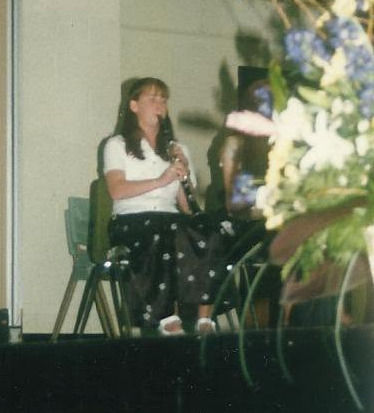
Eventually, listening wasn't enough. I wanted to make music.
I started at church, singing alto in the adult choir because a youth choir did not exist, and then playing clarinet in 6th grade. Then guitar as a 15 year old. I studied voice as a junior to prepare for auditions into college. Eventually, I became a music major double in clarinet and voice, and found myself increasingly fascinated not only with performing music, but with understanding how it was built.
Then came orchestration/arranging and composition. Long before I understood the complexity of my own internal world, I was learning how independent musical lines could exist at the same time.
Melody/Harmony/Rhythm/Countermelody/Dissonance/Resolution/Silence.
Different instruments could be doing completely different things, and somehow, together, they could become one piece of music.
I still remember the first song I ever wrote.
There it was, scribbled in an eighth grader's cursive:
"Mama's Eyes."
I certainly didn't understand then where music would eventually take me, or how deeply it would become intertwined with the way I understand trauma, healing, dissociation, and myself.
But looking back now, it almost feels like I was learning the language of systems before I knew I was a system.

Every Staff Has a Story
When you look at an orchestral score, you see many lines of music. The flute may be carrying the melody while the clarinet answers it. The violins may be moving rapidly while the cello holds something long and steady underneath. The percussion may sit silently for measure after measure and then enter at exactly the moment it is needed.
Sometimes the instruments agree. Sometimes they don't.
Sometimes there is harmony. Sometimes there is intentional dissonance.
And sometimes one voice needs to be louder while another needs to pull back.
Here's the important part: Every staff has a story. Every staff has a purpose, reason, and need.
Remove one because it seems inconvenient, too loud, too repetitive, too strange, or too different, and you may fundamentally change the composition. Perhaps system parts are similar.
Each part carries something.
A memory. A feeling. A job. A fear. A rhythm. A way of seeing the world. A way of surviving it.
Some parts carry things that others could not carry. Some have spent years sounding the alarm.
Some learned how to disappear. Some learned how to perform.
Some learned how to make people laugh. Some learned how to fight.
Some learned how to take care of everyone else.
Some hold grief. Some hold anger.
Some hold wonder. Some still know how to play.
And some may have been resting for a very long time, waiting for the measure where it finally feels safe enough to come in.
Dissonance Isn't Bad Music
As a musician, I learned something else that has become incredibly important to me as a therapist and as a person living with dissociation: Dissonance isn't necessarily a mistake.
Sometimes dissonance is exactly what the composition requires.

It creates movement...Tension...Expectation.
It tells us that something isn't finished yet.
The same can be true internally.
System conflict can be uncomfortable. Parts may have completely different beliefs about safety, relationships, trust, vulnerability, work, sexuality, substances, family, or what healing is even supposed to look like.
One part may say, Go.
Another may say, Don't you dare move.
Another may say, I don't care.
And somewhere underneath all of them might be a very small voice asking, Are we safe yet?
Healing doesn't necessarily mean forcing all of those voices into agreement.
An orchestra doesn't become beautiful because every instrument starts playing the exact same note.
It becomes music because the different voices learn how to listen to one another.
We Don't Need Every Part Playing the Melody
This is one of the places where I think the musical metaphor becomes especially powerful.
Not every instrument is supposed to play the melody.
Imagine an orchestra where every musician decided, My part should be the lead.
It would be chaos.

But the opposite wouldn't work either.
If everyone decided their part wasn't important enough to play, there would be silence.
Healthy collaboration requires something different.
It requires listening, communication, learning when to step forward and when to support.
It requires understanding that accompaniment is not less important than melody.
And it requires recognizing that rests are part of music, too.
For systems, perhaps healing can look less like trying to determine which part is the "real" one and more like becoming curious about the composition.
What does this part carry?
Why did they learn this rhythm?
What are they trying to communicate?
What happens if, instead of trying to silence them, we listen?
What might change if the system begins learning how to play with one another instead of fighting for control of the song?
Not Every System Is an Orchestra
And here's where the metaphor needs to stretch a little further.
Not every system is an orchestra.
Some systems might be orchestras. Others might be jazz combos, garage bands, string quartets, drum circles, choirs, bluegrass groups, rock bands, marching bands, or a handful of people singing a cappella around a kitchen table.

Every system is its own ensemble.
The instrumentation, number of musicians, musical backgrounds and experience all vary.
Some systems have parts who have been communicating and collaborating for years. They have experience playing together. They know one another's tendencies. Maybe they can anticipate when someone else is about to change tempo.
Other systems may have spent most of their lives without realizing there was an ensemble.
Imagine being handed an instrument, walking onto a stage, and suddenly discovering that there are other musicians behind the curtain: Wait. You're here too?
Some parts may be extraordinarily skilled at what they do but have very little experience playing alongside anyone else.
Some may have been told for years that their instrument was too loud, too strange, too angry, too childish, or simply wasn't welcome in the ensemble.
And some may not even know yet that they are allowed to make sound.
There are also tremendous differences in size.
Some systems describe having a relatively small number of parts. Others experience dozens, hundreds, or complex layers and subsystems.
A trio isn't less legitimate than a symphony.
A symphony isn't doing multiplicity "better" than a quartet.
They're simply different ensembles.
And different ensembles require different ways of working together.
Does Every Ensemble Need a Conductor?
Then there is the question of leadership.
We often talk about a "host" as though every system must have one central person standing at the front of the orchestra holding the baton.
But even in music, that's not how every ensemble works.
Certainly, some ensembles benefit from a conductor.
A conductor can help hold the tempo, communicate changes, offer direction, and help musicians see how their individual parts fit into the larger composition.
For some systems, the host may function something like that—a part who spends significant time in daily life and helps coordinate the needs and responsibilities of the system.
And some ensembles and systems don't have or require a conductor/host.
There may be leadership. There may be someone who gives the starting pitch or counts everyone in. Different singers may take the lead at different times. But much of what makes the music work comes from listening closely enough to one another that the group can breathe, adjust, blend, and move together. Nobody has to stand in front waving a baton.
They learn one another.
For some systems leadership is best shared.
Different parts may take the lead in different circumstances.
How do we make music together?
Because cooperation does not always require hierarchy.
And healing does not require every system to reorganize itself into the same kind of ensemble.
The goal isn't to turn a jazz combo into an orchestra.
It isn't to hand an a cappella group a conductor because someone decided that "real" ensembles have conductors.
It's to help each ensemble discover what allows their music to work.
To communicate.
To listen.
To recognize each other's cues.
To recover when somebody misses an entrance.
To improvise when necessary.
To make room when another voice needs to come forward.
And maybe, over time, to trust one another enough that nobody has to spend the entire performance terrified that the music will fall apart.
Music Has Always Given Us Somewhere to Go


Music can also become a bridge between parts.
A song can hold a memory before we have words for it.
A guitar can become grounding.
A rhythm can bring us back into our body.
Lyrics can give language to an emotion that felt impossible to explain.
A song from childhood can bring forward experiences, feelings, or parts of ourselves that seemed impossibly far away only moments earlier.
Sometimes different parts even have different musical tastes.
Of course they do.
Different generations. Different experiences. Different associations. Different emotional needs.
One part may need an angry guitar riff.
Another needs an 80s power ballad.
Someone else needs country music.
Another wants something quiet and acoustic.
Another wants to sing.
Another wants to dance.
And sometimes somebody apparently needs the same song seventeen times in a row.
That's okay, too.
There is room on the playlist.
The Song of My Life
We've written a lot since that first song scribbled in eighth-grade cursive.
We've studied, performed, composed, taught, and used music therapeutically.
I've picked up a guitar when words weren't enough.
And I've come to understand my own life through it.
If the song of my life had a title, I think it would be:
"Trust the Process."

Not Trust the Outcome.
Not Everything Happens for a Reason.
Not Eventually You'll Have It All Figured Out.
Trust. The. Process.
Because compositions don't arrive fully orchestrated.
They develop.
You write something, listen, change it, uncover the musical line underneath what you thought was theme, you erase, rewrite, and end back at a place that resolves the dissonance, or... doesn't.
Healing can be like that.
System work can be like that.
Life can be like that.
There are parts of my own composition that I once wished I could erase. There are sounds I didn't understand, sections I wanted to skip, and movements I thought surely couldn't belong in the same piece.
And they do belong right where they are.
Every staff has a story.
All parts have a story.
All stories need to be heard!
Healing doesn't have to be about learning to be a solo artist. Maybe it's just about figuring out what type of ensemble you're playing in.
We are always in process of our ensemble.... and that's okay!


Comments